 Sale open
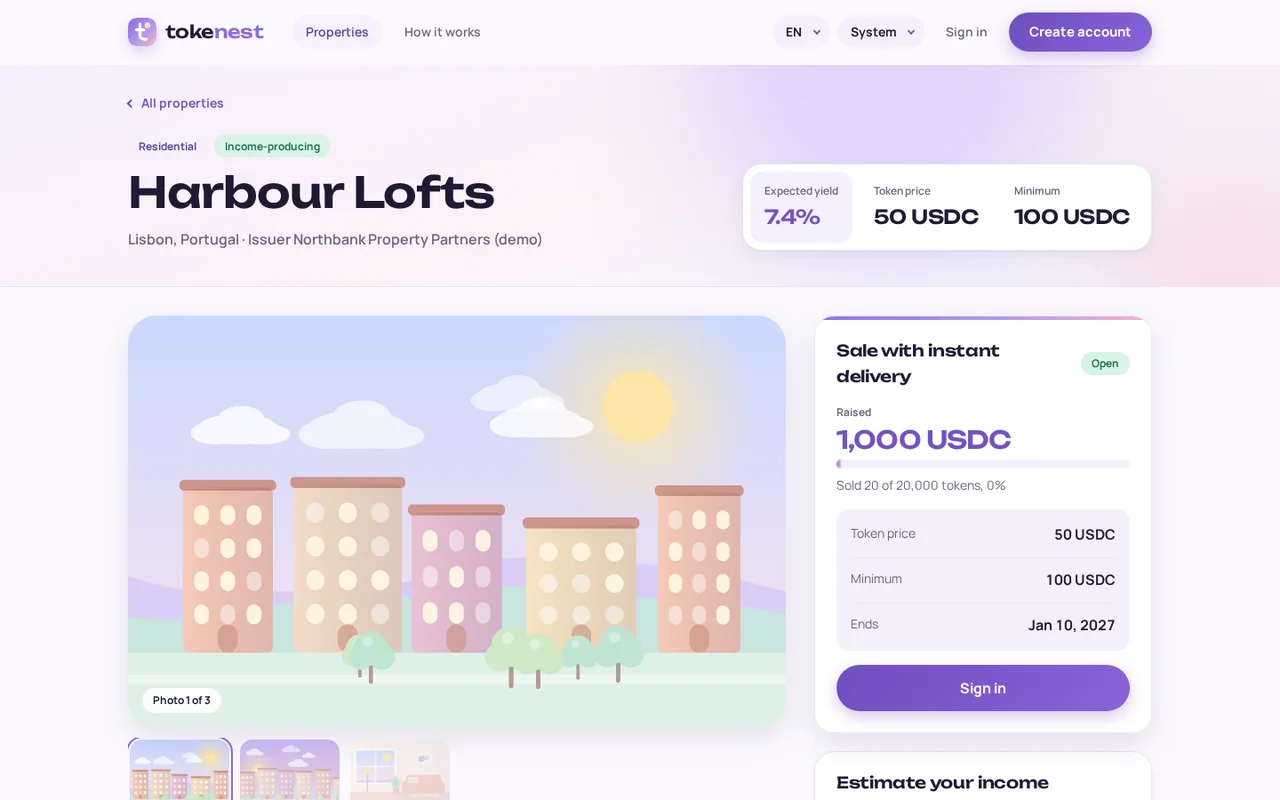
Harbour Lofts, Lisbon Residential · Functioning
- Net yield
- 7.4%
- Token price
- 50 USDC
- Minimum
- 100 USDC
Funded 68%
White-label marketplace, issuer console and compliant smart contracts on Arbitrum. Your brand, your rules, your source code.
ERC-3643 security tokens · Replaceable KYC provider · Arbitrum · Source code included
Every transfer must respect investor eligibility, country rules and holding limits.
KYC, wallets and signatures confuse people who are new to digital assets.
Contracts, indexers, consoles and audits each need a dedicated team.
ERC-3643 tokens check identity, country and limits on every transfer.
An onboarding checklist, plain-language transaction previews and income in USDC.
Source code, contracts and data stay with you. Every external service sits behind a replaceable adapter.
Catalog and asset pages, primary sales in instant or escrow mode, secondary market with a price corridor.
Onboarding checklist, KYC, wallet, portfolio, income calendar and exports.
Asset wizard, data room with document hashes, offerings, payouts and the holder registry.
KYC queue, moderation, fees, country rules, roles, tamper-evident action log and multisig queue.
ERC-3643 compatible security tokens, on-chain investor registry, offering, market and distribution contracts, optional T-REX adapter.
Investors, issuers and your team each work in a dedicated interface under your brand.
Logo, colors, languages, countries, fees and legal pages in one config.
Services start in Docker, contracts deploy to Arbitrum and ownership moves to your multisig.
Issuers prepare properties in their console, your team reviews and tokenizes them.
Primary sales, rental payouts in USDC and a secondary market with a price corridor.
Each step is recorded in the database and on Arbitrum, so issuers, investors and operators see the same state.
Compliance rules are enforced by the contracts, while personal data stays on your servers.
Colors, fonts, logo and domain from one config. Seven languages out of the box, right-to-left ready, legal pages per jurisdiction, source code handover.
Try a theme
| Build in-house | Generic SaaS | Tokenest | |
|---|---|---|---|
| Time to launch | Long | Fast | Fast |
| Source code | Yours | Vendor's | Yours |
| Share of your revenue | None | Often | None |
| Data and keys | Yours | Vendor's | Yours |
Qualitative comparison; timelines depend on your project and legal setup.
A typical plan. Exact timing depends on your legal setup and integrations.
We agree on brand, countries, fees and the KYC provider and deploy a staging copy in your cloud.
Your theme, domain, languages and legal pages, plus the KYC, email and wallet integrations.
Contracts go to Arbitrum under your multisig, issuers upload the first properties.
Team training, a security checklist, the production launch and the source code handover.
Source code, deployment scripts and updates for the agreed period.
Plus configuration, contract deployment and team training.
Plus custom modules, an SLA and dedicated support.
A demo marketplace on Arbitrum One with demo USDC and sample properties.
Sixteen short videos recorded on the demo platform with demo data: from an issuer's application to tokenization, sales, trading, payouts, compliance and deployment for a new client.
A property company applies to the platform from the console: company profile, payout wallet, beneficial owners and documents. The compliance team reviews the application before the company can list any property.
The issuer fills in the property card step by step: description, parameters, token economics, photos, documents and investor rules. A platform manager reviews the card before it moves on to tokenization.
The token price comes from an independent valuation, not from the issuer alone. A platform manager confirms the valuation, and it becomes the reference price of the token.
The platform creates the token of the property on the blockchain, records the reference price and document fingerprints, and publishes the asset in the investor catalog.
A new investor creates an account, passes the identity check and links a wallet. The platform records the wallet in the investor registry on the blockchain, and only registered wallets can hold tokens.
The issuer proposes the terms of a primary sale, and the platform approves them before the sale opens on the blockchain. From then on the sale contract enforces the price, the limits and the time window.
In a sale with instant delivery the investor pays and receives the tokens in the same transaction. The sale contract checks the investor registry and the token rules before it mints the tokens.
In a sale with escrow the payments wait in the sale contract. Tokens are delivered only if the sale reaches its minimum, otherwise every buyer takes the money back.
Holders can resell tokens to other verified investors at a price inside a corridor around the reference price. The tokens stay in the seller's wallet, locked until the offer is filled or cancelled.
A buyer picks an offer of another investor, pays in USDC and receives the tokens in a single transaction. The market contract checks both wallets against the investor registry and the token rules.
Each month the issuer distributes the net rental income. Every holder receives a share in USDC in proportion to the tokens held on the record date, checked against a payout tree on the blockchain.
Investors invite others with a personal link. For a year after an invited investor signs up, the inviter receives a share of the platform fee from that investor's purchases and trades, paid out in USDC rounds.
The contracts check investor rules on every transfer, and the platform team can stop a listing, a sale or trading when something goes wrong. Every action is kept in a tamper-evident action log.
The operator sets its own brand and the functions of the investor site in the console, without developers and without a new release.
A new client gets its own copy of the platform on its own server and in its own brand, from one configuration file and one command.
After launch no single key can upgrade the contracts or grant roles. Control moves to the operator's multisig behind a timelock of 48 hours.
Narration in English, subtitles in your language. Recorded on the demo platform with demo data and the demo stablecoin tUSDC.
Raise funds for new projects from a wide base of verified investors.
Fractional access to portfolios with automated holder records and payouts.
Add tokenized property to your offer under your own brand.
Run the platform in your infrastructure with your compliance stack.
Could not find an answer? Write to hello@tokenest.site.
Real estate first. The data model supports other asset types as well.
Yes. The source code is handed over under the license terms and runs in your infrastructure.
Arbitrum One for production and Arbitrum Sepolia for testing. The contracts are EVM-compatible.
KYC and AML through a replaceable provider, SumSub by default. Eligibility is stored on-chain as signed claims in the investor registry, without personal data.
Rental income is distributed in USDC rounds. Investors claim their share with one transaction.
Yes, on the built-in secondary market to other verified investors, within a price corridor around the valuation.
A legal structure, a KYC provider account, a multisig, a domain and a server. Licenses for the services you choose stay on your side.
The operator of the platform. Tokenest provides compliance tools, not legal advice.
We reply within one business day.